
Academic Activities

-
Academic Activities

Activities
| Poster Image |
|
|---|---|
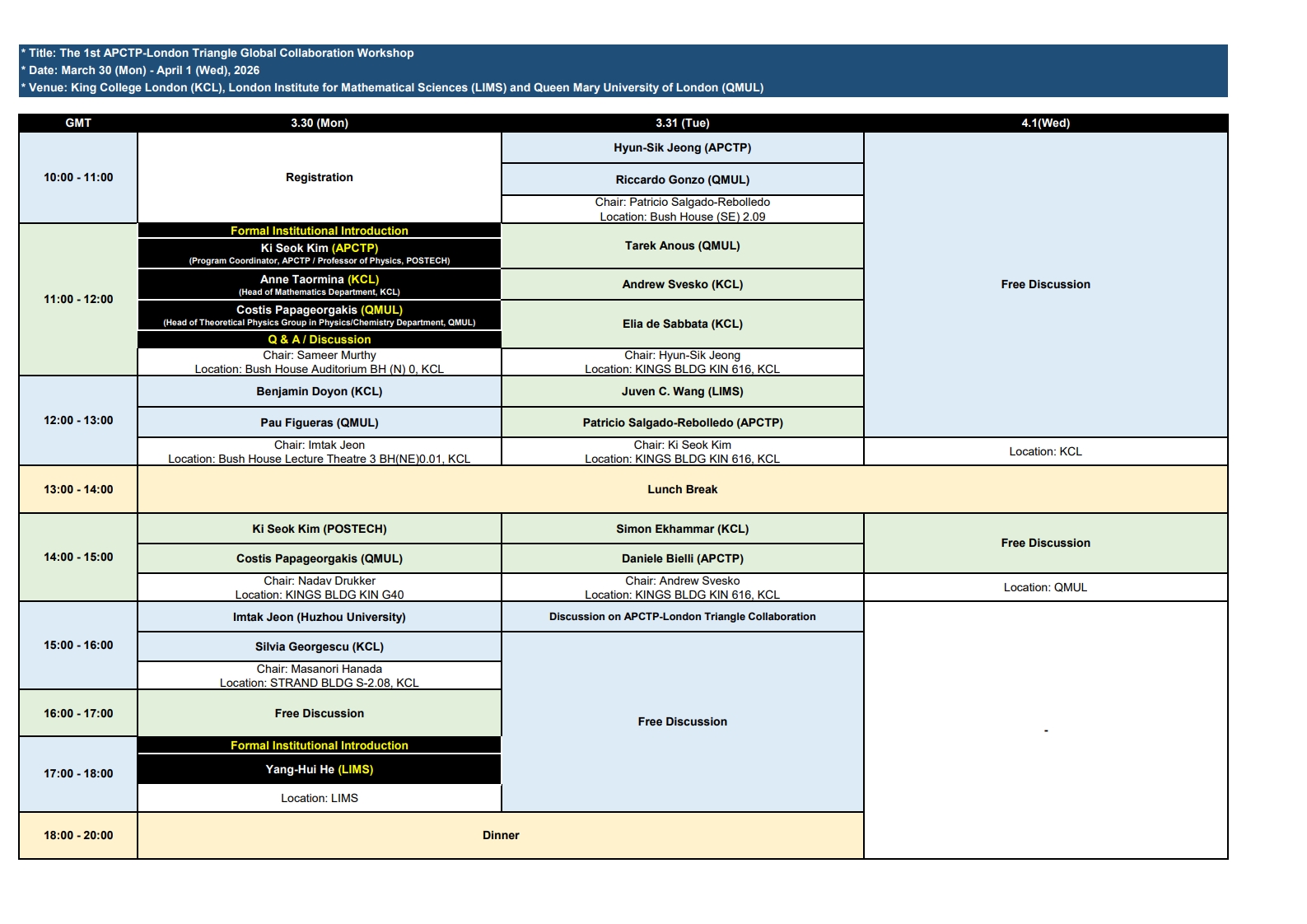
| Title | The 1st APCTP-London Triangle Global Collaboration Workshop |
| Place | King\'s College London (KCL), London Institute for Mathematical Sciences (LIMS) and Queen Mary University of London (QMUL) |
| Date | 2026-03-30~2026-04-01 (Registerable Date : ~ 2026-04-01) |
| Program | Category 4 |
| Organizer |
Patricio Antonio Salgado-Rebolledo (APCTP) Masanori Hanada (Queen Mary University of London) Imtak Jeon (Huzhou University) Sameer Murthy (King's College London) Yang-Hui He (LIMS) |
| Outlink |
https://apctp.org/theme/d/html/activities/activities01_read-pop.php?id=2505&m_id=1258
https://apctp.org/theme/d/html/activities/activities01_read-pop.php?id=2505&m_id=1258
|
| Homepage | http://211.115.127.166/theme/d/html/network/activities01_read-pop.php?id=2505 |
| Confirmed speaker |
Prof. Ki Seok Kim – POSTECH Prof. Anne Taormina – King's College London Prof. Costis Papageorgakis – Queen Mary University of London Prof. Benjamin Doyon – King's College London Prof. Pau Figueras – Queen Mary University of London Prof. Imtak Jeon – Huzhou University Dr. Silvia Georgescu – King's College London Prof. Yang-Hui He - London Institute for Mathematical Sciences (LIMS) Prof. Hyun-Sik Jeong – Asia Pacific Center for Theoretical Physics (APCTP) Dr. Riccardo Gonzo – Queen Mary University of London Prof. Tarek Anous – Queen Mary University of London Dr. Andrew Svesko – King's College London Dr. Elia de Sabbata – King's College London Dr. Juven C. Wang – London Institute for Mathematical Sciences (LIMS) Prof. Patricio Salgado-Rebolledo – Asia Pacific Center for Theoretical Physics (APCTP) Dr. Simon Ekhammar – King's College London Dr. Daniele Bielli – Asia Pacific Center for Theoretical Physics (APCTP) |
| Program |
A three-day joint workshop bringing together researchers from the Asia Pacific Center for Theoretical Physics (APCTP) and leading London-based institutions — King’s College London (KCL), Queen Mary University of London (QMUL), and the London Institute for Mathematical Sciences (LIMS) — to foster research collaborations and explore future institutional partnerships. The workshop aims to strengthen academic ties between Korea and the United Kingdom and to promote long-term scientific cooperation in theoretical physics. Topics / Research Areas Based on the participating institutions and researchers, the scientific themes are expected to include: Black Holes & Quantum Gravity String Theory Mathematical Physics Theoretical High Energy Physics Gauge Theory & Geometry (LIMS/QMUL profile) |
| Talk Title & Abstract |
Prof. Benjamin Doyon (King's College London), Monday 30 March at 12 PM - 1 PM Talk Title: TBA Talk Abstract: TBA Prof. Pau Figueras (Queen Mary University of London), Monday 30 March at 12 PM - 1 PM Talk Title: TBA Talk Abstract: TBA Prof. Ki Seok Kim (POSTECH), Monday 30 March at 2 PM - 3 PM Talk Title: Can you make the shape of a drum from its sound? Talk Abstract: We discuss how to construct the corresponding geometry from the spectrum of a quantum field theory. In particular, we reformulate the functional renormalization group analysis in the path integral representation to find an effective holographic dual field theory for a quantum field theory. Based on this construction, we discuss how the shape of a drum can be reconstructed from its sound. Prof. Costis Papageorgakis (Queen Mary University of London), Monday 30 March at 2 PM - 3 PM Talk Title: Deep Finite Temperature Bootstrap Talk Abstract: We introduce a novel method to bootstrap crossing equations in Conformal Field Theory and apply it to finite temperature theories on S_1×R_d−1. Traditional bootstrap approaches relying on positivity constraints or truncation schemes are not applicable to this problem. Instead, we capture infinite towers of operators using suitable tail functions, which are bootstrapped numerically together with explicit CFT data. Our method employs three key ingredients: the Kubo-Martin-Schwinger (KMS) condition, thermal dispersion relations, and Neural Networks that model spin-dependent tail functions. We test the method on Generalized Free Fields and apply it to bootstrap double-twist thermal data in holographic CFTs. Prof. Imtak Jeon (Huzhou University), Monday 30 March at 3 PM - 4 PM Talk Title: Moduli-dependent One-loop Entropy and Quantum Attractor Mechanism in AdS4 BPS Black Holes Talk Abstract: We study one-loop logarithmic corrections to the entropy of static hyperbolic BPS black holes in asymptotically AdS4 spacetime within N=2 Fayet–Iliopoulos gauged supergravity. In this setup, the classical BPS attractor mechanism exhibits flat directions, leaving scalar moduli on the horizon unfixed while the Bekenstein–Hawking entropy depends only on the charges. We show that quantum corrections induce a nontrivial dependence of the entropy on the horizon moduli, generating an effective quantum potential that dynamically stabilizes them. This provides an explicit realization of the quantum lifting of classical attractor flat directions. We will also comment on implications for the quantum structure of AdS black holes and possible connections to holography. Dr. Silvia Georgescu (King's College London), Monday 30 March at 3 PM - 4 PM Talk Title: Conformal boundaries near cosmological horizons Talk Abstract: We investigate the dynamics of linearised perturbations around the de Sitter static patch, in the presence of a timelike boundary with conformal boundary conditions. Inspired by the case of global AdS4, for which the limit in which the conformal boundary approaches the asymptotic boundary reveals a hierarchy of real modes, we consider the limit in dS4 in which the conformal boundary approaches the cosmological horizon. In this limit, potential perturbations that grow exponentially in time are attenuated. We find a hierarchy of modes that localise near the conformal boundary, suggesting a holographic interpretation. Prof. Hyun-Sik Jeong (APCTP), Tuesday 31 March at 10 AM - 11 AM Talk Title: Neural Network-Based Methods for Inverse Problems in Holography Talk Abstract: Holography (AdS/CFT) provides a powerful framework for studying the quantum nature of gravity and strongly coupled quantum systems. This talk showcases how deep neural networks can address inverse problems in holography: specifically, reconstructing bulk gravity models from boundary observables. By integrating holography with physics-informed neural networks, we show that strongly coupled systems, from QCD-like theories to condensed-matter models and entanglement-based setups, can be analyzed in a data-driven and robust way. The aim is to demonstrate how machine-learning methods enable stable, consistent reconstructions and offer new insights that complement traditional holographic approaches. Dr. Riccardo Gonzo (Queen Mary University of London), Tuesday 31 March at 10 AM - 11 AM Talk Title: What particle theory teaches us about binary black holes Talk Abstract: Particle physics is changing the way we think about gravity. In recent years, scattering amplitudes and effective field theory methods have led to major new insights into the gravitational two-body problem, with increasing impact on gravitational-wave modelling. These developments are also helping to uncover new synergies between different perturbative approaches, such as post-Minkowskian, post-Newtonian and gravitational self-force theory. In this talk, I will briefly review the main ideas behind this programme and discuss some recent progress and future directions. Prof. Tarek Anous (Queen Mary University of London), Tuesday 31 March at 11 AM - 12 PM Talk Title: TBA Talk Abstract: TB Dr. Andrew Svesko (King's College London), Tuesday 31 March at 11 AM - 12 PM Talk Title: Quantum black holes at world's end Talk Abstract: Semi-classical gravity is a useful proxy to study quantum effects in gravity. Yet, generically, consistent solutions to the semi- classical Einstein equations accounting backreaction remain out of reach, limiting our understanding of quantum corrections to black hole physics. In this talk, I review the construction of three-dimensional quantum black holes. Such spacetimes live on holographic end-of-the- world branes and are exact solutions to an induced higher-derivative theory of gravity consistently coupled to a large-c conformal field theory, accounting for all orders of semi-classical backreaction. I will describe the geometry and thermodynamics of a host of (anti-) de Sitter quantum black holes, and survey applications of these constructions. Dr. Elia de Sabbata (King's College London), Tuesday 31 March at 11 AM - 12 PM Talk Title: TBA Talk Abstract: TBA Dr. Juven C. Wang (London Institute for Mathematical Sciences), Tuesday 31 March at 12 PM - 1 PM Talk Title: Topological Observables Beyond the Standard Model, and Universal Quantum Computation Talk Abstract: We discuss the topological response (analogous to fractional symmetry-protected topological states [SPTs]) that can distinguish the global structure of the SM gauge group, SU(3)×SU(2)×U(1)/ℤq, for q=1,2,3,6, involving 0-symmetry, 1-symmetry, symmetry-twist group homomorphism, and symmetry frationalization obstruction (G[0], G[1], ρ, [β]) and symmetry-fractionalization class k ∈ [BG[0], B^2G[1]]. We further introduce a new integer n series of baryon-minus-lepton (B−L)-like U(1) symmetries, Xn≡n(B−L)+(1−n/Nc)Ỹ to derive the fractional topological response σ_n(q,k)=q(1−n)gcd(2,n)/(2n)+kq/6 mod 1. Using pairs such as (n1,n2)=(2,3) or a single n=7 can uniquely distinguish the symmetry-enriched SM(q,k), based on [arXiv:2412.21196]. In a different setting, we propose that topological order can replace sterile neutrinos as dark matter candidates to cancel the Standard Model’s global gravitational anomalies. Standard Model (SM) with 15 Weyl fermions per family (lacking the 16th, the sterile right-handed neutrino νR) suffers from mixed gauge-gravitational anomalies tied to baryon number plus or minus lepton number B±L symmetry. Including νR per family can cancel these anomalies, but when B±L symmetry is preserved as discrete finite subgroups rather than a continuous U(1), the perturbative local anomalies become nonperturbative global anomalies. We systematically enumerate these gauge-gravitational global anomalies involving discrete B ± L that are enhanced from the fermion parity ZF2 to ZF2N, constrained by multi-fermion deformations and the family number Nf. Unlike the free quadratic νR Majorana mass gap preserving the minimal ZF2, we explore novel symmetric anomalous sectors as quantum dark matter canceling (B ± L)-gravitational anomalies while preserving the ZF2N discrete symmetries, featuring 4-dimensional interacting gapped topological orders or gapless sectors (e.g., conformal field theories) or 5-dimensional bulk. We find the uniqueness of the family number at Nf = 3, such that when the representation of ZF2N from the faithful B + L for baryons at N = Nf = 3 is extended to the faithful Q + NcL for quarks at N = NcNf = 9, this symmetry extension ZNc=3 → ZNcNf =9 → ZNf =3 matches with the topological order dark matter construction. Key implications include: (1) a 5th force mediating between SM and dark matter via discrete B±L gauge fields, (2) dark matter as topological order quantum matter with gapped anyon excitations at ends of extended defects, and (3) Ultra Unification and topological leptogenesis, based on [arXiv:2501.00607, arXiv:2502.21319, arXiv:2512.25038, arXiv:2411.05786, arXiv:2012.15860]. In parallel, we are motivated to braid non-abelian Fibonacci anyons in string-net condensates to realise fault-tolerant universal quantum computation, under IBM Quantum [arXiv:2406.12820]. Prof. Patricio Salgado-Rebolledo (Asia Pacific Center for Theoretical Physics), Tuesday 31 March at 12 PM - 1 PM Talk Title: TBA Talk Abstract: TB Dr. Simon Ekhammar (King's College London), , Tuesday 31 March at 2 PM - 3 PM Talk Title: TBA Talk Abstract: TB Dr. Daniele Bielli (Asia Pacific Center for Theoretical Physics) Talk Title: TBA Talk Abstract: TBA |